Showing posts with label coping skills. Show all posts

Monday, January 8, 2018

Jigsaw Puzzles as Coping Tools


By Amy Grabowski, MA, LCPC
In my Thursday evening Women’s Therapy group we were discussing tools and resources for dealing with anxiety. We talked about deep breathing and yoga. Then one woman said, “Jigsaw puzzles.” The group stopped, considered that for a while, and the discussion veered towards how perfect jigsaw puzzles were for anxiety relief.
“It keeps my hands busy.”
“My mind focuses on the colors and shapes rather than what I’m worried about.”
 “I don’t eat while doing a jigsaw puzzle—I don’t even think about food!”
“It gives me something to talk about when spending time with my Dad.”
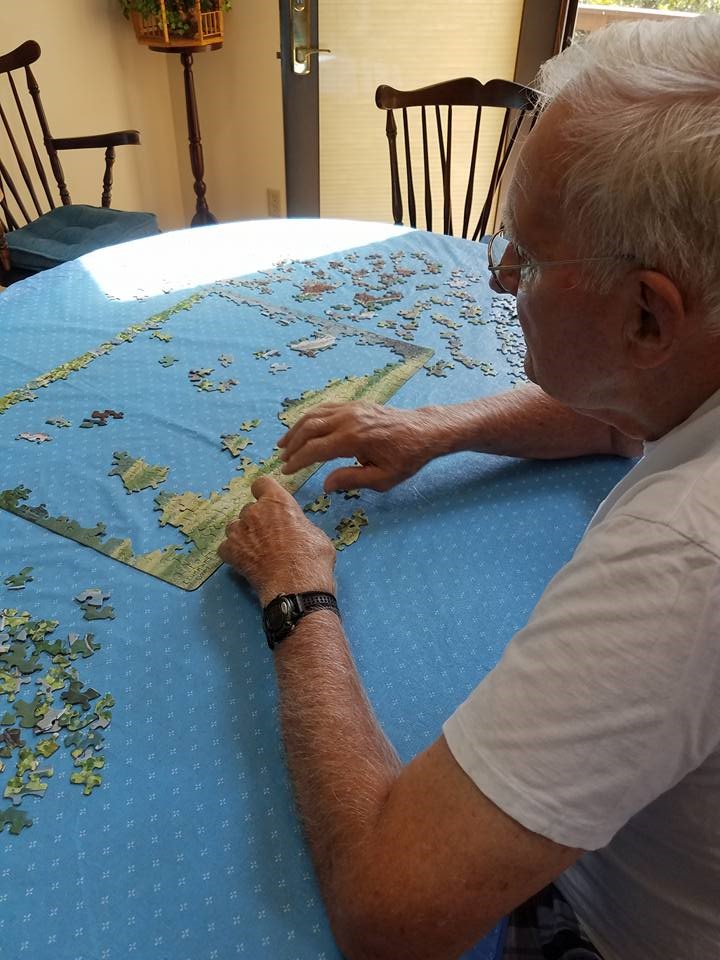
I love jigsaw puzzles. There’s something calming and very Zen about building a jigsaw puzzle—starting with the edges and then working inward to complete the image. Every New Years Day, my family and I build a jigsaw puzzle. I bring a puzzle when I visit with my Dad. (Yes, that was my comment above) He’s a hard person to talk to, but we can spend hours building the puzzle and we talk at length about the various colors and shapes and the difficulty. 
I was curious about why puzzles are so calming and did some research. Doing jigsaw puzzles exercises both halves of your brain: the left brain uses logic and sequence while the right brain uses creativity and spatial imagery. Exercising both halves of the brain has been shown to decrease the risk of developing dementia or Alzheimer’s disease!
The production of dopamine is increased while doing jigsaw puzzles. In the simplest of terms, this is the chemical in the brain that keeps us happy and healthy. It is also responsible for reward-seeking behavior. Every time you find the correct puzzle piece your brain registers a “reward.” And there’s a sense of pride and accomplishment when you finally put in the last piece! 
While building a puzzle you concentrate and become more attentive, while at the same time your mind can roam around all the pieces until you spot the piece that fits. It is a form of meditation, which makes you feel calm and peaceful!
There are physical advantages as well by lowering the rate of respiration, reducing blood pressure, and decreasing the heart rate.
Here’s a short piece about jigsaw puzzles. I hope you enjoy it!
Everything I Need to Know About Life I Learned From a Jigsaw Puzzle
By Jacqui Sewell
• Don't force a fit. If something is meant to be, it will come together naturally.
• When things aren't going so well, take a break. Everything will look different when you return.
• Be sure to look at the big picture. Getting hung up on the little pieces only leads to frustration.
• Perseverance pays off. Every important puzzle went together bit by bit, piece by piece.
• When one spot stops working, move to another. But be sure to come back later (see above).
• The creator of the puzzle gave you the picture as a guidebook.
• Variety is the spice of life.  It's the different colors and patterns that make the puzzle interesting.
• Establish the border first. Boundaries give a sense of security and order.
• Don't be afraid to try different combinations. Some matches are surprising.
• Take time to celebrate your successes (even little ones).
• Anything worth doing takes time and effort. A great puzzle can't be rushed.
     I have started a Jigsaw Puzzle lending library located in the stairwell at The Awakening Center. You can “check out” a jigsaw puzzle and return it (with all pieces, please!) when you are done. 

            If you would like to donate used puzzles, feel free to give it to your Awakening Center therapist or group leader!  Thank you!  

Peacefully,
Amy
Amy is the Founder and Director of The Awakening Center, and she loves puzzles of any kind! 


Monday, August 31, 2015

Meditation Monday: Replacing Illusions with Values


By Nancy Hall, MA, NCC, LPC
In an effort to take the “manic” out of “Monday,” this weekly post explores techniques, issues, latest research, and other thoughts on meditation. Nancy facilitates a weekly meditation group at The Awakening Center. For more information, contact her at 773.929.6262, extension 17 or nancyhalltac@gmail.com

When we examine our coping behaviors, how many are truly reliable? Or even actually helpful for that matter? We often take refuge in behaviors or habits that we believe give us control or comfort. But when we can step back and connect to our own clarity, we realize that we’re believing in an illusion.

Instead of giving true comfort or control, many behaviors leave behind shame and regret; self-compassion becomes difficult. The need for comfort and soothing remains present and we turn to our old habits. Then more shame, and the cycle continues

But the short-term rewards of unhealthy coping behaviors seem so great; the desire to numb, distract, disconnect, soothe. The needs at the core of these urges are never quite satisfied. Instead, cravings remain, triggering behaviors, triggering more cravings, and so on.

The urges and cravings take up space in thoughts and feelings. As you begin to connect to your deep wise self, what can you place at the center of your life? What gives you true comfort, soothing, peace?

Take a moment and connect to a behavior or belief that has caused you suffering yet it still takes up a prominent position within you. Perhaps it’s not at the center, but it might be a behavior or belief that seems hard to live without

How have you relied on this behavior? Whether it’s an addiction or compulsion, have you clung to it? What are the consequences?

Check in with your body to notice if any tension or stress has crept back in. Re-engage with your breathing—let it anchor you.

Now, take a moment to ask yourself, what matters to you? What inspires you?

Where are you able to experience stillness…compassion…curiosity…peace?

As you experience the calmness of this moment, ask yourself, what can you truly put your trust in? God as you understand? Nature? Goodness of people? Yourself? A combination?

Whatever that looks like to you, allow yourself to connect to that trust. Where can you turn when you suffer? Where do you go to find your values?

Again, there is no right answer. And the image might not be clear—just let the possibility exist. If you are not sure where you can turn to find values or trust, see what it feels like to turn somewhere…even if you don’t have a clear idea of where that is.

This We Have Now

This we have now
is not imagination

This is not
grief or joy

Not a judging state,
or an elation
or sadness

Those come and go.
This is the presence that doesn’t.
--Rumi

Wednesday, December 23, 2009


“Your Holiday Toolbox”


So here we are, smack in the middle of the holiday season- that 6-week period between Thanksgiving and New Year’s. How are you doing in this stressful time? Are you reeling from that Thanksgiving dinner and hoping to make it through Christmas unscathed? Are you counting down to when life returns to normalcy? Or are you embracing each challenge that this holiday season brings with quiet determination and clarity of thought?

The New York Times published an article entitled “Duck! It’s the holidays” (by Joyce Walder, Nov 18, 2009) that relates the story of Eric Marcus, a 51-year-old NYC writer who invited his mother to Thanksgiving dinner at his home. Despite the wide array of food prepared by professional cooks that were also guests at this gathering, she complained loudly about the lack of a sweet potato dish. Marcus felt that this was just typical behavior on her part as she often found a way to be disappointed no matter the situation.

“Suddenly I’m 12 years old and we are someplace when she says something inappropriate and embarrassing yet again,” Mr. Marcus said in the article. “All her life, she has a habit of saying negative things.”

Does this sound oh so familiar to you? The holidays, with all their revelry and celebration, are often a minefield of negativity for many families. By merely bringing so many family members together, the holidays often trigger age-old family dynamics that have their roots in childhood. No matter if you are 50 or 15, you might find yourself in that caretaker or mediator or rebel or parent role just one more time.

If you have an eating disorder, the holidays might be so distressing to you that you might find yourself resorting to old and destructive ways of relating to food. There is just something about the magnetic pull of family dynamics that sees many of us engaging in old and unhealthy coping mechanisms that we thought we had grown out of.

For me, I know that whenever I face an interaction with my family, be it a mere phone call, a casual dinner or a Christmas party, I have found it useful to take some active steps to ensure that I can take care of myself should the old triggers reappear. Some steps include:

1) Plan, plan, plan: Prepare for potentially triggering situations by talking about your fears and insecurities with a therapist or with a good friend. You might want to draw up a game plan with several constructive things you can do if a distressing situation occurs. If you have an open and cooperative relationship with your family, you might want to send them an email in advance to politely request that they avoid talking about or doing certain things that might distress you.

2) Fill up your toolbox: You want to bring a variety of coping skills to the family dinner table so that you have healthy alternatives other than what you are so used to doing. You might want to write down several self-care activities that you know will be effective in soothing you- walking a walk, bringing a good book, updating your playlist with your favorite music are all good options. Sometimes, when these aren’t possible (maybe you can’t walk away from the dinner table) taking a good, deep breath helps a ton.

3) Lastly, be kind to yourself. If you do find yourself engaging in old patterns of behavior, try to really let it go and forgive yourself. It is important, when you fall, to recognize the fact that your past efforts and that the holidays are a really difficult time for almost everyone.

So for this holiday season, I wish you a time of healthy eating and healthy thought, and a time of non-judgment and self-acceptance.


Jolene Hwee is a master's level practicum intern from Northwestern University.

* The NYT article can be found at
http://www.nytimes.com/2009/11/19/garden/19manners.html?pagewanted=1&_r=1&sq=duck!%20its%20the%20holidays&st=cse&scp=1