Showing posts with label recovery tools. Show all posts

Monday, January 8, 2018

Jigsaw Puzzles as Coping Tools


By Amy Grabowski, MA, LCPC
In my Thursday evening Women’s Therapy group we were discussing tools and resources for dealing with anxiety. We talked about deep breathing and yoga. Then one woman said, “Jigsaw puzzles.” The group stopped, considered that for a while, and the discussion veered towards how perfect jigsaw puzzles were for anxiety relief.
“It keeps my hands busy.”
“My mind focuses on the colors and shapes rather than what I’m worried about.”
 “I don’t eat while doing a jigsaw puzzle—I don’t even think about food!”
“It gives me something to talk about when spending time with my Dad.”
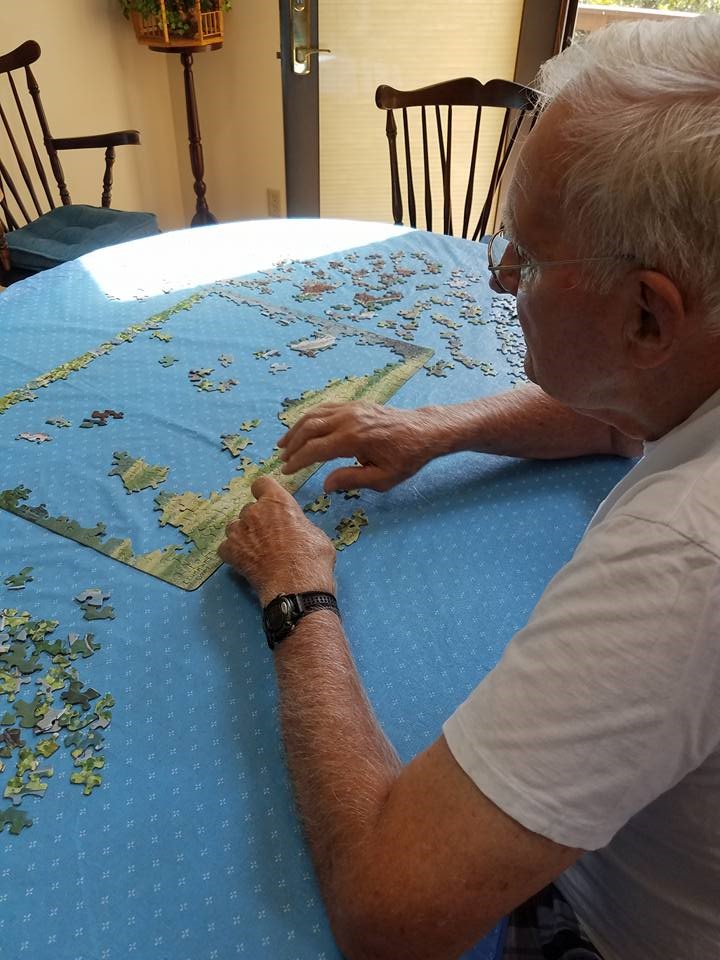
I love jigsaw puzzles. There’s something calming and very Zen about building a jigsaw puzzle—starting with the edges and then working inward to complete the image. Every New Years Day, my family and I build a jigsaw puzzle. I bring a puzzle when I visit with my Dad. (Yes, that was my comment above) He’s a hard person to talk to, but we can spend hours building the puzzle and we talk at length about the various colors and shapes and the difficulty. 
I was curious about why puzzles are so calming and did some research. Doing jigsaw puzzles exercises both halves of your brain: the left brain uses logic and sequence while the right brain uses creativity and spatial imagery. Exercising both halves of the brain has been shown to decrease the risk of developing dementia or Alzheimer’s disease!
The production of dopamine is increased while doing jigsaw puzzles. In the simplest of terms, this is the chemical in the brain that keeps us happy and healthy. It is also responsible for reward-seeking behavior. Every time you find the correct puzzle piece your brain registers a “reward.” And there’s a sense of pride and accomplishment when you finally put in the last piece! 
While building a puzzle you concentrate and become more attentive, while at the same time your mind can roam around all the pieces until you spot the piece that fits. It is a form of meditation, which makes you feel calm and peaceful!
There are physical advantages as well by lowering the rate of respiration, reducing blood pressure, and decreasing the heart rate.
Here’s a short piece about jigsaw puzzles. I hope you enjoy it!
Everything I Need to Know About Life I Learned From a Jigsaw Puzzle
By Jacqui Sewell
• Don't force a fit. If something is meant to be, it will come together naturally.
• When things aren't going so well, take a break. Everything will look different when you return.
• Be sure to look at the big picture. Getting hung up on the little pieces only leads to frustration.
• Perseverance pays off. Every important puzzle went together bit by bit, piece by piece.
• When one spot stops working, move to another. But be sure to come back later (see above).
• The creator of the puzzle gave you the picture as a guidebook.
• Variety is the spice of life.  It's the different colors and patterns that make the puzzle interesting.
• Establish the border first. Boundaries give a sense of security and order.
• Don't be afraid to try different combinations. Some matches are surprising.
• Take time to celebrate your successes (even little ones).
• Anything worth doing takes time and effort. A great puzzle can't be rushed.
     I have started a Jigsaw Puzzle lending library located in the stairwell at The Awakening Center. You can “check out” a jigsaw puzzle and return it (with all pieces, please!) when you are done. 

            If you would like to donate used puzzles, feel free to give it to your Awakening Center therapist or group leader!  Thank you!  

Peacefully,
Amy
Amy is the Founder and Director of The Awakening Center, and she loves puzzles of any kind! 


Wednesday, December 17, 2014

Think, Before Acknowledging


By Michel Harris, RD, LDN, CDE


 One of my clients, who recently achieved her goal weight, arrived to our session looking defeated. She explained that her attempt to donate blood turned humiliating when the receptionist commented on her thin appearance and then announced to the entire room how much she weighed. A second client, who is close to her goal weight, endures hurtful comments from her co-workers on a daily basis. They cannot seem to stop reminding her of how lucky she is to “eat anything she wants and stay so thin.”

The way in which these people behaved towards my clients reminds me of a scene from the movie “Splash.” Darryl Hannah is in a department store purchasing underwear, and the saleslady, while trying to sell her something fancier, commented on her appearance, then said “My daughter-in-law, on the other hand is lucky, she’s anorexic.” For both of my clients, the remarks of others sting because having an eating disorder makes them feel anything but lucky. Just like the saleslady in “Splash,” these comments seem to equate underweight and thinness as a status everyone desires. While they wouldn't be expected to know the circumstances that my clients have faced, they have acted disrespectfully by assuming they enjoy being recognized for their appearance.

You may think that underweight and thin have the same meaning, but to clarify, underweight refers to someone who is not at his or her desired weight for health. A thin person is at a healthy weight but is often viewed as underweight by those who are dissatisfied by their own appearance.

As a dietitian, I have heard just as many stories involving humiliation of underweight and thin clients, as I have of those who are overweight or obese. However, since the media promotes underweight and thinness as the appearance everyone strives for, it is assumed that weight-related comments are welcomed by this population.

When you are about to ask your friend why she is eating yogurt or exercising because she is so thin, stop and remind yourself that she may be struggling with accepting her own body or maybe she is very confident with living a healthy lifestyle. Remember, you don’t know her life story or how she came to her current appearance.


I will close with a line from one of my favorite songs by the artist Monica: “Just one of them days a girl goes through.” While this song is about a relationship in which the girl apologizes to her boyfriend for wanting to be alone sometimes, I used to play this song in my college days when I was having a poor body image day. All of us, despite our body size, have days in which we are uncomfortable with our body. Let’s support each other and acknowledge our non-physical attributes.

Michel Harris is the staff nutritionist at The Awakening Center. She counsels clients individually and in group. Check back on the Calendar page for updates on new groups in 2015. Michel is accepting new clients, so call 773-929-6262 for more information.

Monday, September 15, 2014

Tools for Our Recovery Toolbox


As a famous Psychologist Abraham Maslow once said, “When your only tool is a hammer, all problems start to look like nails.”

Imagine a carpenter who only had one tool – a hammer.  If you hired this carpenter to hang pictures, the carpenter would pull out the hammer and do a fine job.  But what if you asked the carpenter to shorten the legs of a table.  When the carpenter pulled out the hammer, you would wonder why?  And if you allowed the carpenter to use the hammer to shorten the table legs, the table would probably be ruined.   

The same is true with our Eating Disorder.  When our only tool is eating (or starving, purging, overexercising, counting calories etc etc etc ), we have to rely on this tool for everything that happens in our life.  We get a promotion – Eat!  Have a fight with your sister – Eat!   Your cat dies – Eat!   Nothing to do on a Friday night – Eat!  I know you get the picture! 

So what happened?  Why do we only have 1 tool in our toolbox?    There are four reasons why Eating (or starving etc) became our only tool. 

1)      If we continually use a tool, the tool stays at the top of the toolbox.  After a while, we forget how to use the other tools we have.  For example, you don’t have to risk asserting yourself if you continually numb out angry feelings by eating.
2)      There may have been basic tools that we never learned – our families couldn’t teach us what they didn’t know.  For example, if no one in your family ever spoke up and asserted themselves, you may not have learned how to do this.
3)      On the other hand, our family may have taught us some pretty dysfunctional tools that don’t work very well at all.  For example, if you learned that if people loved you they would just “know” what is bothering you , you would try to make people read your mind rather than telling them what you need or want.
4)      This reason is going to contradict what I just said above.  Even though I say Eating (starving, etc.) is our only tool – we actually have lots of tools.  We are already good at problem solving, compassion, reassurance, kindness, and many, many others.  It’s just that we use these tools for other people, and don’t use them for ourselves.   We may say we don’t deserve to treat ourselves in a positive way.

It is possible to learn new tools and un-learn old dysfunctional tools.  With practice the new tools will become familiar and become our “go to” coping tool.   And if we stop using Eating (starving, etc) as a tool to deal with everything that happens in life, this tool with sift to the bottom of the toolbox.   And if you don’t use this tool, eventually using Eating (starving, etc) will be foreign to us as well.  

If you would like to learn 10 Recovery Tools to put in your Recovery Toolbox, please join Nutritionist Michel Harris and I on Saturday 9/20/14 from 12:300-4:30pm. 

For more information, please click link below.
Namaste,
Amy Grabowski

Amy is the Director of The Awakening Center – which she Founded 20 years ago!  She has over 30 years of personal recovery experience!